


The leap from traditional mechanical and electrical ignition to optical ignition represents one of the most exciting advancements in modern combustion engineering. At the forefront of this revolution is the Laser igniter 100w, a powerful tool that brings unprecedented precision, efficiency, and control to industrial and aerospace applications. However, with great power comes the absolute necessity for stringent safety protocols and a deep understanding of optical physics. Best way to find the Laser igniter 100w.
Whether you are a facility manager upgrading your industrial burners, an aerospace engineer testing new propulsion systems, or a technician tasked with maintaining these advanced optical tools, understanding the nuances of a 100w laser igniter is paramount. This comprehensive guide will walk you through the physics of optical ignition, the strict safety protocols required to operate high-wattage lasers, equipment maintenance, and the exciting future of this technology.
Understanding the Physics of Optical Ignition
Before we dive into the safety and maintenance of a Laser igniter 100w, it is essential to understand the underlying science. Lasers do not ignite fuel by simply “heating” it up like a magnifying glass in the sun; they rely on complex quantum mechanics and high-energy physics.
How Does Optical Breakdown Ignition Work?
If you are new to optical combustion, you might be asking: how does optical breakdown ignition work? The process relies on focusing a high-intensity laser beam into an incredibly small, microscopic focal point inside a combustion chamber.
When the laser pulse hits this focal point, the electric field of the light becomes so intense that it literally rips electrons away from the gas molecules in the fuel-air mixture. This initiates the multiphoton ionization process in gases. In this phase, a single gas molecule simultaneously absorbs multiple photons, gaining enough energy to free an electron.
Once a few initial electrons are freed, they are accelerated by the laser’s electric field, colliding with other molecules and freeing more electrons in a chain reaction known as “avalanche ionization.” This rapid cascading effect generates a localized, high-temperature plasma spark (often exceeding 10,000 Kelvin) in a matter of nanoseconds. This plasma spark acts as the ignition source, rapidly propagating a flame front through the combustible mixture.
Laser Ignition vs Traditional Spark Plugs
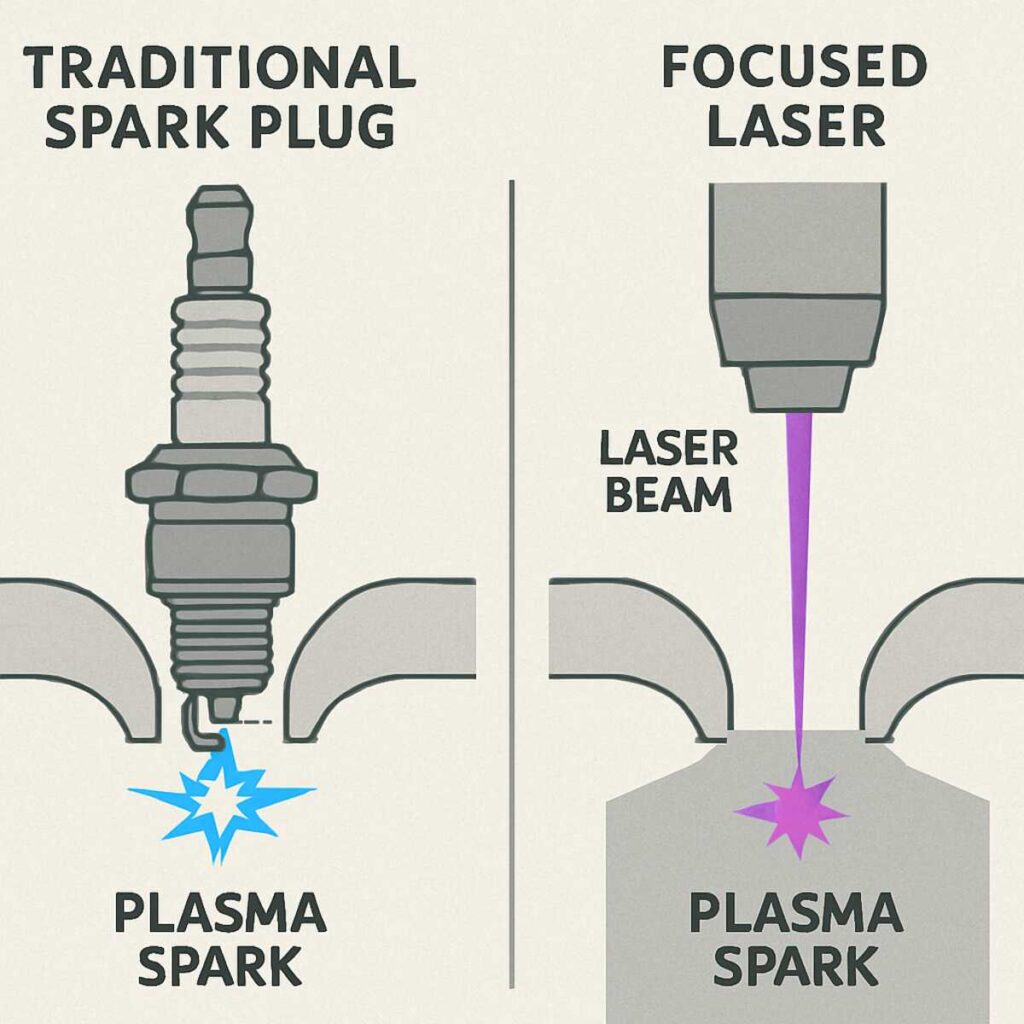
To truly appreciate the technology, we must look at laser ignition vs traditional spark plugs. Traditional spark plugs have been the standard for over a century, relying on high voltage jumping across a physical metal gap to create a spark. However, they suffer from significant limitations that lasers effortlessly overcome:
- Electrode Wear: Traditional spark plugs degrade over time because the electrical discharge and the harsh combustion environment erode the metal electrodes. Lasers have no components inside the combustion chamber.
- Fixed Ignition Point: Spark plugs can only ignite the fuel-air mixture at the exact location of the cylinder wall where they are mounted. A laser can be focused to ignite the mixture directly in the center of the chamber, resulting in a faster, more even burn.
- Lean Burn Capabilities: Lasers generate a much higher energy plasma spark than electrical plugs, allowing them to ignite significantly leaner fuel mixtures. This drastically reduces NOx emissions and improves fuel economy.
The overarching theme here is the non-contact combustion initiation advantages. Because the laser optics are safely situated behind a protective sapphire or quartz window, away from the explosive heat and pressure of the combustion event, the system’s lifespan is dramatically increased.
The Core Components of a 100W Laser Igniter
A modern optical ignition setup is a highly complex assembly of advanced optics, synthetic crystals, and precise electronics.
High Power Fiber Coupled Laser Module
Most industrial systems utilize a high power fiber coupled laser module. Instead of mounting a bulky, fragile laser directly onto an engine or furnace, the laser diode bank is kept in a safe, temperature-controlled cabinet. The light is then transported via a flexible, ruggedized fiber optic cable to the ignition site. This fiber coupling ensures that the fragile laser diodes are protected from the severe vibrations and acoustic shocks inherent in industrial environments.
The Role of Synthetic Crystals
At the heart of many of these systems is a synthetic crystal that acts as the gain medium. Understanding yttrium aluminum garnet crystal properties is key to understanding why Nd:YAG (Neodymium-doped Yttrium Aluminum Garnet) lasers are the industry standard for ignition.
- Thermal Conductivity: YAG crystals can dissipate heat rapidly, which is critical when operating at 100 watts of power.
- Optical Clarity: They provide excellent optical transparency, allowing for highly efficient light amplification.
- Durability: YAG crystals are mechanically robust, ensuring long-term stability even in demanding environments.
Continuous Wave vs. Pulsed Operation
When configuring your system, it is crucial to understand the difference between pulse energy vs continuous wave output. While a 100W continuous wave (CW) laser outputs 100 joules of energy every second steadily, it generally cannot trigger optical breakdown. The intensity at any given microsecond is too low. Instead, laser igniters use pulsed output. By compressing that 100W of average power into ultra-short pulses (often in the nanosecond or picosecond range), the peak power of a single pulse can reach megawatts. It is this massive spike in peak power that drives the multiphoton ionization required to spark the fuel.
Strict Safety Protocols for High-Power Lasers
Operating any laser over 500 milliwatts (0.5W) places it firmly in the Class 4 laser category—the highest and most dangerous class. A 100W laser is 200 times this threshold. If mishandled, it can cause instant, irreversible blindness, severe third-degree burns, and catastrophic facility fires.
1. Eye Protection Requirements for Class 4 Lasers
The single most critical safety measure is eye protection. A stray reflection from a 100W beam—even scattered off a mildly reflective surface like a metal wrench or a glossy table—can permanently destroy the retina in a fraction of a second, faster than your blink reflex.
Meeting the eye protection requirements for class 4 lasers involves selecting safety goggles with the correct Optical Density (OD) for the specific wavelength of your laser.
- Wavelength Matching: Most Nd:YAG laser igniters operate at an infrared wavelength of 1064nm. Your safety glasses must explicitly state they block 1064nm.
- Optical Density (OD): OD is a logarithmic scale measuring how much light the glasses block. An OD of 1 blocks 90% of the light; OD 2 blocks 99%. For a 100W Class 4 laser, you typically need glasses with an OD of 6 or 7 at your specific wavelength.
- Condition Checks: Always inspect your laser safety glasses for scratches, cracks, or photobleaching before every use. A compromised lens offers zero protection.
2. Skin and Fire Hazards
Infrared lasers are invisible. You will not see the beam, but you will certainly feel it if it hits you. A 100W focused beam will cut through human tissue, clothing, and plastic effortlessly.
- Always wear fire-resistant, tightly woven laboratory coats.
- Ensure the beam path is fully enclosed in metal beam tubes wherever possible.
- Remove all flammable solvents, paper, and combustible materials from the optical table or testing area.
3. Engineering Controls and Interlocks
Facility design is just as important as personal protective equipment (PPE).
- Door Interlocks: The room housing the laser must be equipped with magnetic door interlocks. If someone accidentally opens the door while the laser is active, the interlock instantly cuts the power to the laser diodes.
- Warning Signs: Illuminated “Laser On” warning signs must be placed outside the room.
- Beam Dumps: Any stray or unabsorbed laser energy must be directed into specialized, water-cooled beam dumps made of non-reflective, heat-absorbing materials.
Operational Best Practices and Setup
Once your safety protocols are in place, the operational setup determines whether your system will successfully ignite fuel or simply waste energy.
Steps to Align Laser Ignition Optics
Improper alignment will result in a distorted focal point, meaning the laser will fail to create a plasma spark. Follow these steps to align laser ignition optics carefully:
- Secure the Environment: Ensure all safety interlocks are engaged, and all personnel in the room are wearing appropriate OD-rated eyewear.
- Use a Low-Power Alignment Laser: Never align a system using the full 100W output. Most systems feature a low-power, visible red targeting laser (usually around 632nm). Turn this on first.
- Mount the Collimator: Ensure the light exiting the fiber optic cable is perfectly collimated (parallel). Use an infrared viewing card to check the beam profile.
- Position the Focusing Lens: Place your focusing lens into the optical path. The goal is to focus the beam through the protective window of the combustion chamber.
- Center the Beam: Use precision micrometers on your optical mounts to ensure the red alignment beam hits the exact dead-center of the focusing lens. If the beam hits the lens off-center, it will suffer from spherical aberration, ruining your focal point.
- Determine the Focal Plane: Adjust the Z-axis (distance) of the lens until the focal point rests precisely where you want the ignition to occur inside the chamber (e.g., the center of the fuel-air vortex).
- Lock and Test: Lock all optical mounts firmly. Fire a single, test pulse at the operating power into a safe testing medium (like ambient air) to verify plasma generation.
The Importance of Beam Quality
During alignment, you must consider the quality of the laser beam itself. In optical physics, this is measured by the M² (M-squared) factor.
The beam quality factor M2 importance cannot be overstated. An M² of 1.0 represents a perfect, theoretically flawless Gaussian beam. The higher the M² number, the lower the beam quality. Why does this matter for ignition? A laser with a poor M² factor cannot be focused into a microscopic, tight spot. Instead, the focal point will be blurry and spread out. If the energy is spread out, the peak intensity drops, and you will not achieve the optical breakdown needed to spark the fuel. Always source laser modules with an M² factor as close to 1.0 as possible for ignition applications.
Maintenance and Thermal Management
A high-power optical system requires rigorous maintenance to ensure longevity and reliability. Heat and dust are the two greatest enemies of a laser igniter.
Managing Heat Dissipation in High Wattage Lasers
Laser diodes are only about 40% to 50% efficient. This means a laser generating 100 watts of optical light is likely generating 100 to 150 watts of waste heat. Managing heat dissipation in high wattage lasers is critical to prevent the diodes from burning out or shifting their output wavelength.
- Thermoelectric Coolers (TECs): For the internal laser diodes, TECs (Peltier devices) are used to actively move heat away from the diode junctions, keeping them at a stable temperature (usually around 20°C to 25°C).
- Active Water Chilling: The TECs themselves generate heat, which must be removed. Industrial setups utilize closed-loop water chillers. Deionized water is pumped through microchannel cold plates directly beneath the laser modules.
- Flow Monitoring: Always ensure your chiller is equipped with flow and temperature sensors. If the water stops flowing, a 100W laser can destroy itself in seconds. Your control system should automatically shut off the laser if coolant flow drops.
Cleaning Optical Lenses for High Power Systems
In a 100W system, a microscopic speck of dust on a lens is not just an annoyance; it is a critical failure waiting to happen. If a speck of dust rests on the focusing lens, the intense laser light will instantly vaporize the dust, burning a permanent crater into the lens coating.
Follow this strict protocol for cleaning optical lenses for high power systems:
- Blow Off Debris: Use analytical-grade, compressed nitrogen or a manual bulb blower to remove loose dust. Never use standard workshop compressed air, as it contains microscopic oil droplets that will ruin the lens.
- The “Drop and Drag” Method: Take a sheet of lint-free, optical-grade lens tissue. Place it flat over the lens. Apply one or two drops of spectroscopic-grade solvent (usually high-purity methanol or acetone) to the tissue resting on the lens.
- Pull Slowly: Slowly and gently pull the damp tissue across the surface of the lens. The surface tension of the solvent will pull any remaining debris off the lens without causing microscopic scratches.
- Never Scrub: Never rub or scrub an optical lens in a circular motion. The optical coatings applied to these lenses are incredibly thin and delicate.
Industrial and Economic Impacts
The transition to optical ignition is not just a scientific novelty; it has massive implications for industrial efficiency and economics.
Industrial Furnace Remote Ignition Systems
One of the most rapid adoptions of this technology is found in industrial furnace remote ignition systems. Large-scale smelting plants, chemical refineries, and power generation facilities rely on massive gas burners.
Historically, igniting these burners required long mechanical spark rods. These rods are subjected to extreme heat and corrosive gases, leading to frequent failures and costly plant shutdowns for maintenance. By retrofitting these burners with fiber-coupled optical ignition, facilities can keep the sensitive electronic and laser components safely in a control room hundreds of feet away. The only component exposed to the furnace is a passive sapphire window and a focusing lens, practically eliminating maintenance-related downtime.
Cost of High Power Laser Diodes
While the benefits are clear, facility managers must weigh the economics. Historically, the cost of high power laser diodes was prohibitively expensive, keeping this technology restricted to laboratory research.
However, thanks to advances in telecom and automated manufacturing, the cost per watt of laser diodes has plummeted over the last decade. While an optical ignition system still carries a higher upfront capital expenditure than a traditional spark plug system, the Return on Investment (ROI) is realized rapidly through:
- Elimination of Maintenance Downtime: No more shutting down a multi-million-dollar furnace to replace burnt-out igniters.
- Fuel Efficiency: The ability to ignite leaner mixtures saves massive amounts of fuel over a year of continuous operation.
- Component Longevity: Solid-state laser diodes are rated for tens of thousands of hours of operation.
Looking to the Horizon: Aerospace and Beyond
The most exciting frontier for this technology lies in the skies above us and the vacuum of space.
Future of Laser Ignition in Aerospace Engines
The future of laser ignition in aerospace engines is incredibly promising. In commercial aviation, jet turbine engines operate under extreme pressures and speeds. If a jet engine suffers a “flameout” at high altitude (due to ingesting ice or heavy rain), restarting it quickly is a matter of life and death.
Traditional electrical igniters struggle to spark lean fuel mixtures in the freezing, thin air of high altitudes. Laser igniters, with their massive plasma energy, can reliably reignite turbine engines in milliseconds, regardless of altitude or temperature.
Furthermore, in rocket propulsion, engineers are looking to lasers to replace heavy, volatile chemical ignition systems (like hypergolic fluids). A fiber-coupled laser network could ignite multiple rocket engine stages simultaneously with zero moving parts, saving critical weight and vastly improving the safety of space launch vehicles.
Conclusion
The integration of a 100w laser igniter into industrial and aerospace applications represents a monumental shift in how we control combustion. By harnessing the power of multiphoton ionization, we can achieve cleaner burns, infinite ignition positioning, and maintenance-free operation in the harshest environments on Earth.
However, harnessing this light requires an unwavering commitment to safety. Proper eye protection, rigorous thermal management, meticulous optical alignment, and pristine lens cleaning protocols are not mere suggestions—they are the absolute foundational rules of operating high-power optics.
As the cost of laser diodes continues to fall and fiber optic technology becomes even more resilient, optical ignition will soon shift from a high-tech specialty to the global standard. By understanding the physics, respecting the safety hazards, and mastering the operational protocols outlined in this guide, you will be perfectly positioned to lead the charge into the future of advanced combustion.
