


Ecuador is rapidly becoming a premier destination for international investors, expatriates, digital nomads, and forward-thinking entrepreneurs. With its use of the US dollar, diverse economy, and welcoming culture, the country offers unique opportunities. However, beneath the surface of stunning Andean peaks and pristine Pacific beaches lies a complex, constantly evolving financial and regulatory landscape. Read the Best info about servicios contables en Ecuador.
Whether you are launching a startup in Quito, opening an export business in Guayaquil, or working remotely from Cuenca, understanding local tax laws is non-negotiable. The secret to long-term success here is not just having a great business model—it is finding the right financial professional. Navigating this terrain requires top-tier accounting services in Ecuador to ensure compliance, optimize tax burdens, and protect your investments.
This comprehensive guide will walk you through everything you need to know about managing your finances in this beautiful South American nation, from corporate regulations to hiring the perfect local expert.
The Financial Landscape: Why You Need Professional Help in Ecuador
Ecuadorian tax and corporate laws are notoriously intricate and subject to frequent changes. The national tax authority operates with a strict set of rules that require meticulous attention to detail. Attempting to manage your own bookkeeping or relying on an unqualified professional can lead to severe financial consequences, frozen bank accounts, or even the closure of your business.
The Role of the Tax Authority
The country’s tax system is overseen by the SRI (Servicio de Rentas Internas). This institution is modern, highly digitized, and rigorous in its enforcement. Familiarizing yourself with Servicio de Rentas Internas regulations is the first step toward business stability. The SRI requires monthly declarations for Value Added Tax (VAT) and income tax withholdings, alongside an annual income tax return.
Because the SRI uses a sophisticated cross-referencing system via electronic invoicing (facturación electrónica), discrepancies between what you report and what your suppliers or clients report are instantly flagged. Professional accounting services ecuador are essential because local accountants understand the nuances of this electronic ecosystem and can prevent mismatches that trigger audits.
Starting a Business: From Conception to Compliance
For a foreign investor, establishing a legal entity in Ecuador involves several bureaucratic hurdles. A skilled accountant does more than just balance the books; they act as an essential advisor during the incorporation phase.
Understanding the Requirements
When looking into starting a business in Ecuador requirements, you will find that the process is specific and requires coordination between lawyers, notaries, and accountants. The general steps include:
- Reserving a Company Name: Conducted through the Superintendency of Companies.
- Drafting and Notarizing Bylaws: Creating the foundational legal document for your business (Escritura Pública).
- Capital Integration: Opening a temporary integration account at a local bank and depositing the minimum required capital.
- Commercial Registration: Registering the company with the local Mercantile Registry.
- Obtaining a Tax ID (RUC): Registering with the SRI to receive your Registro Único de Contribuyentes.
A certified accountant is crucial during the RUC registration phase, as they must formally accept the responsibility of being your company’s registered accountant in the SRI system.
Corporate Tax Compliance for Foreign Companies
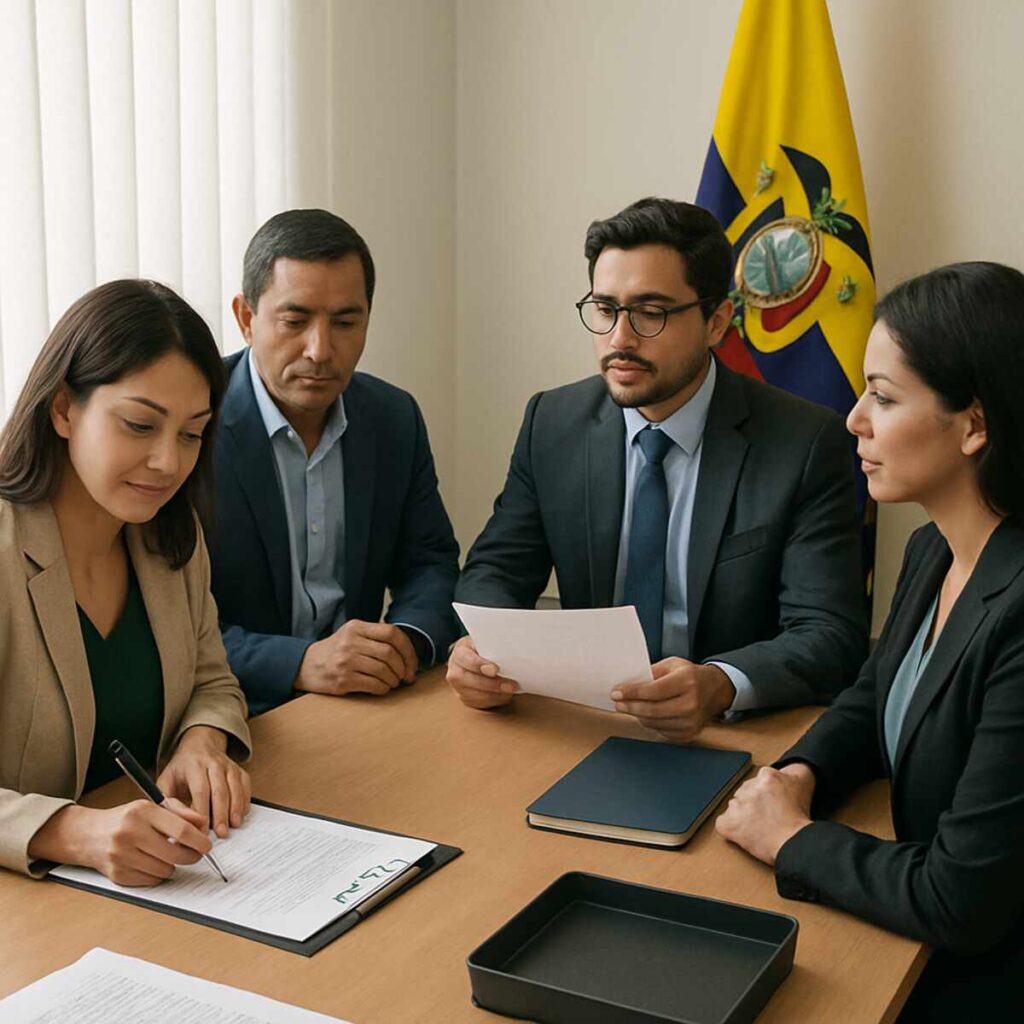
Operating as a subsidiary or a branch of a foreign company carries its own set of rules. Ensuring corporate tax compliance for foreign companies is vital to avoid double taxation and legal liabilities.
Ecuador taxes resident companies on their worldwide income, while non-resident companies are only taxed on their Ecuador-sourced income. If you are a foreign entity, your accountant will help you structure your operations to optimize your tax position. They will track deductible expenses, manage depreciation schedules, and ensure that profit repatriations comply with local capital exit taxes (ISD – Impuesto a la Salida de Divisas), though recent governmental reforms have aimed at progressively reducing this specific tax to attract more foreign capital.
Local Versus International Audit Standards
As your foreign enterprise grows, you may be required to undergo statutory audits. It is crucial to understand the bridge between local versus international audit standards. While Ecuadorian statutory audits are heavily focused on strict adherence to SRI tax codes and local labor laws, international standards (ISA) focus broader attention on risk assessment, internal controls, and going concern principles. If your parent company requires consolidated financial statements, you must hire a professional who understands both local compliance and international audit expectations.
The Essential Guide: How to Hire an Accountant in Ecuador
Finding a trustworthy accountant is arguably the most important business decision you will make upon arriving in the country. But how do you separate the average bookkeepers from the strategic financial partners?
Look for a Certified Professional
You do not just need someone good with numbers; you need a CPA ecuador. In Ecuador, a Certified Public Accountant (Contador Público Autorizado) holds a specific university degree and possesses a professional registration number. This certification allows them to legally sign your financial statements and tax declarations. An uncertified bookkeeper cannot legally represent you before the SRI or the Superintendency of Companies.
Bilingual Bookkeeping
If your primary language is English and your parent company is based in the US, UK, Canada, or Australia, you need seamless communication. Bilingual bookkeeping for international investors is not just a luxury; it is a critical risk-management tool.
Your accountant should be able to translate local financial realities—such as the complexities of the 13th and 14th salaries—into terms that your overseas board of directors or personal financial planners can easily understand. Furthermore, they should be capable of generating financial reports in both Spanish (for local authorities) and English (for stakeholders).
Steps: How to Hire an Accountant in Ecuador
When determining how to hire an accountant in Ecuador, follow these actionable steps:
- Ask for Referrals from the Expat/Investor Community: Chambers of Commerce (like the Ecuadorian-American Chamber of Commerce) and expat business groups are excellent resources.
- Verify Their Registration: Ask for their CPA registration number and ensure they are in good standing with the local professional board.
- Interview for Industry Experience: An accountant who specializes in agricultural exports may not be the best fit for a software-as-a-service (SaaS) startup. Ask about their experience with your specific business model.
- Discuss Technology: Ensure they are comfortable with modern, cloud-based accounting systems.
- Test Communication: Evaluate their responsiveness and ability to explain complex Ecuadorian tax concepts simply.
Staying in the SRI’s Good Graces: Avoiding Penalties
The SRI operates on a strict calendar based on the ninth digit of your RUC (Tax ID) number. Missing a deadline by even a single day results in automatic fines and interest.
Avoiding Tax Penalties from the SRI
The key to avoiding tax penalties from the SRI is proactive communication with your accountant. Penalties in Ecuador are not just financial; the SRI has the authority to suspend your RUC, effectively freezing your ability to issue invoices, clear customs, or conduct business legally.
To avoid issues, ensure you:
- Deliver all expense invoices to your accountant well before the monthly deadline.
- Keep digital backups of all XML files from electronic invoices.
- Ensure your accountant provides you with the filing receipts (comprobantes de recepción) every month as proof of compliance.
Value Added Tax (IVA) Intricacies
The standard Value Added Tax (IVA) in Ecuador is 15% (subject to change based on current economic legislation), but several goods and services are rated at 0%. Properly classifying these is essential.
Furthermore, certain demographics and business types are entitled to VAT refunds. Understanding Value Added Tax recovery procedures is an area where a great accountant pays for themselves. For instance:
- Exporters: Can claim back the VAT paid on raw materials and services used to produce exported goods.
- Seniors (Tercera Edad): Individuals over 65 can request monthly refunds on VAT paid for personal consumption.
- People with Disabilities: Are also entitled to specific VAT recovery procedures. Your accountant must navigate the SRI’s online portal to submit the required matrices and documentation to secure these refunds promptly.
Accounting Standards and Financial Reporting
Ecuador has modernized its accounting frameworks to align more closely with global standards, replacing the old Ecuadorian Accounting Standards (NEC) with international frameworks.
Financial Reporting under NIIF for PYMES
For small and medium-sized enterprises, the regulatory body requires financial reporting under NIIF for PYMES (Normas Internacionales de Información Financiera para Pequeñas y Medianas Entidades). This is the Spanish equivalent of IFRS for SMEs.
Adopting NIIF for PYMES ensures that your financial statements are transparent, consistent, and comparable to businesses worldwide. Your accountant must be thoroughly trained in these standards to properly evaluate assets, calculate depreciations, and recognize revenues. This is particularly crucial if you plan to seek local bank financing or sell your business in the future, as investors and banks require NIIF-compliant financial statements.
Superintendencia de Compañías Annual Filings
While the SRI handles taxes, the Superintendencia de Compañías, Valores y Seguros (Superintendency of Companies) regulates corporate governance. By April 30th of each year, companies must submit their Superintendencia de Compañías annual filings.
These mandatory filings include:
- The annual financial statements (Balance Sheet, Income Statement, Cash Flow Statement, Statement of Changes in Equity).
- The General Manager’s annual report.
- The Statutory Auditor’s report (Comisario), if applicable.
- Minutes from the annual shareholders’ meeting approving the financials. Failure to submit these documents results in heavy fines and a public “in bad standing” status for the company, which can block banking activities and contract signings.
Labor Laws and Payroll Management
If you plan to hire employees in Ecuador, prepare for a highly regulated labor environment that heavily favors the employee. Payroll here is not as simple as calculating an hourly wage.
What are IESS Employer Obligations?
The Ecuadorian Social Security Institute (IESS) requires strict adherence to monthly contributions. Understanding what are IESS employer obligations is critical to avoiding devastating labor lawsuits.
Key components include:
- Monthly Contributions: The employer pays 11.15% of the employee’s gross salary to IESS, while 9.45% is deducted from the employee’s salary.
- 13th Salary (Bono Navideño): An annual bonus equivalent to one month’s salary, paid in December.
- 14th Salary (Bono Escolar): An annual bonus equivalent to one unified basic salary (SBU), paid just before the school year starts (timing depends on the coastal or highland region).
- Reserve Funds (Fondos de Reserva): After one year of employment, the employer must pay an additional 8.33% of the employee’s salary into their IESS fund or directly to the employee.
- Profit Sharing (Utilidades): Companies must distribute 15% of their net pre-tax profits to their employees annually.
Payroll Outsourcing Benefits for Small Businesses
Given the massive complexity of calculating overtime, vacation pay, reserve funds, and managing IESS portals, many foreign investors opt for external help. Exploring payroll outsourcing benefits for small businesses reveals significant advantages.
By outsourcing, you eliminate the need to purchase specialized payroll software and reduce the risk of mathematical errors that could lead to labor ministry fines. It allows you to maintain a lean administrative team while ensuring your employees are paid accurately and legally every time.
Technology in Ecuadorian Accounting
The days of handing your accountant a shoebox full of crumpled physical receipts are mostly over in Ecuador. The SRI is one of the most technologically advanced tax authorities in Latin America.
The Era of Electronic Invoicing
Electronic invoicing is now mandatory for almost all taxpayers in Ecuador. When you make a business purchase, the vendor asks for your RUC and email. The invoice is generated digitally and sent simultaneously to your email and directly to the SRI’s database.
Cloud-Based vs Traditional Accounting Software
This digital shift makes the choice of software incredibly important. When comparing cloud-based vs traditional accounting software, cloud solutions offer distinct advantages for the modern expatriate or foreign investor.
Traditional, desktop-based local software (often built specifically for Ecuador) handles local tax matrices well, but it restricts your access to the physical office and rarely offers English interfaces.
Conversely, cloud-based platforms like Xero or QuickBooks Online allow business owners to view real-time financial dashboards from anywhere in the world. However, these international platforms do not natively integrate with the SRI’s electronic invoicing system. Therefore, top-tier accounting firms in Ecuador use local API bridges or middleware to sync international cloud-based software with the SRI, giving you the best of both worlds: local compliance and global accessibility.
Specialized Tax Considerations: Digital Nomads and Expats
Ecuador is actively courting location-independent workers and retirees. With the introduction of the digital nomad visa (Rentista for Remote Work), a new wave of professionals has entered the country, bringing specific tax questions.
Tax Residency Status for Digital Nomads
Living in Ecuador on a nomad visa does not automatically make you a tax resident, but staying long enough will. Generally, determining tax residency status for digital nomads comes down to the 183-day rule. If you spend more than 183 days (consecutive or not) in Ecuador within a 12-month period, the SRI considers you a tax resident.
Once you are a tax resident, you are theoretically liable for income tax on your worldwide income. However, Ecuador recognizes that digital nomads are bringing foreign currency into the local economy. An experienced accountant will help you structure your income and legally declare your taxes without paying more than your fair share.
Double Taxation Treaties in Ecuador
To prevent foreign workers and investors from being taxed twice on the same income (once in their home country and once in Ecuador), the government has established international agreements.
Leveraging double taxation treaties in Ecuador is a primary strategy for expats. Ecuador has treaties with several countries, including Canada, Spain, Switzerland, and various Latin American nations (via the Andean Community agreements). Notably, Ecuador does not currently have a comprehensive double taxation treaty with the United States. US citizens must therefore rely on the Foreign Earned Income Exclusion (FEIE) or Foreign Tax Credits via the IRS, working in tandem with their Ecuadorian CPA to minimize liabilities.
Top 10 Actionable Tips for Working with Your Ecuadorian Accountant
To ensure a smooth, profitable relationship with your financial professional in Ecuador, implement these best practices:
- Demand a Service Level Agreement (SLA): Clearly define what is included in the monthly retainer (e.g., monthly SRI filings, IESS management, yearly Supercias filings).
- Keep Business and Personal Separate: Never use your corporate bank account for personal expenses (like groceries or personal travel). The SRI strictly monitors non-deductible expenses.
- Understand “Gastos Deducibles”: Ask your accountant for a clear list of what counts as a deductible business expense in your specific industry.
- Hold Monthly Reviews: Do not wait until the end of the year to look at your profit and loss statement. Schedule a 30-minute monthly Zoom call with your accountant.
- Plan for “Utilidades”: If your business is profitable, remember that 15% goes to employees and 25% to corporate income tax. Budget for this cash outflow early in the year.
- Secure Your Credentials: Your accountant will need your SRI and IESS passwords to file on your behalf. Ensure these are securely shared and change them if you change accountants.
- Embrace Digital Signatures: Obtain an electronic signature (Firma Electrónica) immediately. It is required for electronic invoicing and signing legal documents, saving you trips to the notary.
- Prepare for Capital Exit Taxes: If you plan to send large sums of money out of Ecuador (dividends to a foreign parent company), consult your accountant on the current ISD (Impuesto a la Salida de Divisas) rates and exemptions.
- Monitor Retentions (Retenciones): In Ecuador, larger companies act as withholding agents. If you sell to a large corporation, they will withhold a percentage of the VAT and Income Tax and pay it directly to the SRI. Your accountant must track these “comprobantes de retención” meticulously, as they act as a credit toward your end-of-year tax bill.
- Do Not Ignore Municipal Taxes: While the SRI handles national taxes, you must also pay a yearly municipal patent (Patente Municipal) and the 1.5 per thousand tax (1.5 por mil) based on your total assets to the local city government where your business operates.
Conclusion: Securing Your Financial Future in Ecuador
Doing business in Ecuador is a rewarding experience, offering access to emerging markets, a strategic geographic location, and a fantastic quality of life. However, the administrative burden of operating legally cannot be understated. The regulatory environment is designed to ensure strict compliance, and ignorance of the law is never an acceptable defense in the eyes of the SRI or the Ministry of Labor.
Choosing the right partner for your financial management is the foundation of your success. By focusing on finding a fully registered professional, demanding bilingual communication, and ensuring they are up-to-date with digital trends and international reporting standards, you mitigate your risks entirely.
Whether you need help understanding what your IESS employer obligations are, navigating the complexities of Value Added Tax recovery procedures, or simply finding a reliable partner for accounting services in Ecuador, taking the time to vet and hire the right expert will grant you peace of mind. With your books balanced, taxes filed on time, and payroll managed legally, you can focus on what you came to Ecuador to do: grow your business and enjoy everything this magnificent country has to offer.
