
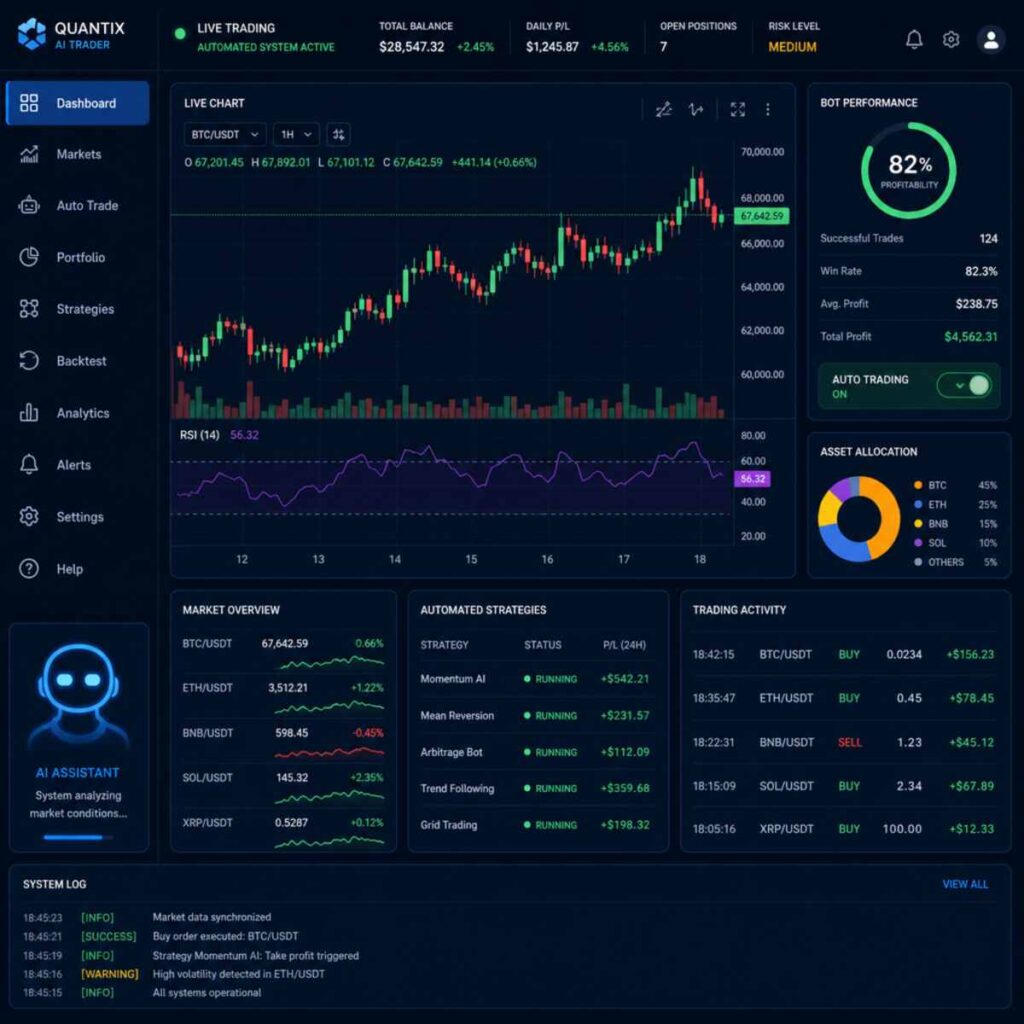
The image of a frantic trader yelling across a crowded stock exchange floor is a relic of the past. Today, the global financial markets are dominated by cold, calculating machines processing millions of data points per second. For the modern retail investor, this digital revolution has opened the door to auto trading, a landscape where software programs execute trades on your behalf 24 hours a day, 7 days a week. Read the Best info about APY.
But as the barrier to entry lowers, a new challenge arises: navigating the vast sea of available software and choosing the platform that aligns perfectly with your financial goals, technical expertise, and risk tolerance. Whether you want to sleep soundly while your portfolio trades the Asian session or you are looking to remove human error from your daily routine, finding the right platform is the foundational step to success.
This comprehensive guide will demystify the world of automated finance. We will explore everything from the core mechanics of algorithmic strategies to the subtle technical details that can make or break your profitability.
The Core Mechanics of Auto Trading
To make an informed decision about which platform to use, you must first understand what is happening under the hood. Auto trading (often referred to as system trading) involves using a computer program to buy and sell financial instruments automatically.
From Concept to Execution
At its core, algorithmic trading relies on rule-based trade execution logic. This means that a human trader creates a set of specific criteria—such as moving average crossovers, volume spikes, or specific price actions—and translates them into code. Once the live market conditions meet these exact mathematical criteria, the software instantly triggers an order.
The beauty of this system lies in its absolute objectivity. There is no second-guessing, no hesitation, and no fatigue. The rules are absolute.
Trading Bots vs. Black Box Systems
When researching platforms, you will frequently encounter various terms used interchangeably. While trading bots are typically transparent programs where you can see (and alter) the underlying strategy, you might also come across proprietary systems.
This leads many beginners to ask: how does a black box system work? A “black box” is a highly complex, proprietary algorithmic system where the internal workings—the specific rules, formulas, and quantitative models—are hidden from the user. You feed money into the system (the input), and it executes trades to generate a result (the output). While black box systems can be powerful, they require an immense amount of trust in the developer, as you cannot audit the logic driving your financial decisions. Most retail investors are better served by transparent platforms where the rule-based logic is visible and customizable.
Addressing the Elephant in the Room: Are Investment Bots Profitable?
Before investing time and capital into a platform, we must address the most common question in the industry: are investment bots profitable?
The short answer is yes, they can be. The realistic answer is that they are not magic money-making machines. A trading bot is simply a vehicle; the profitability depends entirely on the engine—the strategy you program into it.
The Myth of the “Set It and Forget It” Bot
Many platforms market themselves as passive income generators where you can turn on a bot and walk away. In reality, markets are highly dynamic. A strategy that works brilliantly during a trending bull market will likely incur heavy losses during a choppy, sideways market.
Profitable automated trading requires:
- Constant Monitoring: Ensuring the software is functioning correctly and the market regime hasn’t shifted.
- Strategy Refinement: Tweaking your approach as market volatility expands and contracts.
- Realistic Expectations: Targeting sustainable, risk-adjusted returns rather than overnight wealth.
If a platform promises guaranteed, sky-high daily returns with zero risk, it is highly likely a scam. The right platform provides you with robust tools to build and test your own profitable systems, rather than selling you an impossible dream.

The Psychological Edge of Automation
While speed and 24/7 market access are frequently touted benefits, the single greatest advantage of automation is psychological.
Reducing Emotional Bias in Financial Markets
Human beings are notoriously bad at trading due to our evolutionary psychology. We are wired to feel the pain of a loss twice as intensely as the joy of a gain (loss aversion). This leads to classic trading errors: holding onto losing positions hoping they bounce back, and selling winning positions too early out of fear they will reverse.
By offloading the execution to an algorithm, you are directly reducing emotional bias in financial markets. The bot does not feel fear during a sudden market crash, nor does it feel FOMO (Fear Of Missing Out) when an asset’s price skyrockets. It simply executes the plan. Choosing a platform that allows for complete automation—removing the need for manual confirmation prompts—is vital to maintaining this psychological edge.
Types of Automated Trading Approaches
The right platform for you depends entirely on the type of automated trading you wish to pursue. Let’s break down the most popular approaches.
1. Algorithmic Trading Systems for Beginners
If you are new to the space, you don’t need a degree in computer science to get started. Many modern platforms offer algorithmic trading systems for beginners that utilize “no-code” or “drag-and-drop” interfaces. You can visually link indicators (e.g., “If RSI < 30” AND “Price > 200 EMA”) to create a fully functional bot. These platforms are perfect for learning the ropes without getting bogged down in Python or C++ syntax.
2. Computerized Currency Exchange Strategies
The Forex market operates 24/5 across different global time zones, making it a prime candidate for automation. Computerized currency exchange strategies often involve grid trading, mean reversion, or trend-following across major pairs like EUR/USD or GBP/JPY. Platforms catering to Forex usually integrate directly with MetaTrader 4 or 5 and require robust hosting solutions to ensure uptime during crucial market sessions.
3. Social Copy Trading vs Algorithmic Strategies
Many investors debate the merits of social copy trading vs algorithmic strategies.
- Social Copy Trading: This involves automatically mirroring the trades of a human expert. It is incredibly easy to set up, but you are reliant on the emotional stability and performance of another person.
- Algorithmic Strategies: This requires you to build or buy a software script. It takes more setup time but provides ultimate control and consistency. Some hybrid platforms allow you to copy the trades of other people’s algorithms, bridging the gap between the two.
4. High Frequency Trading (HFT)
While mostly the domain of massive Wall Street institutions, it is worth understanding the high frequency trading market impact. HFT involves executing thousands of trades in fractions of a second to capture microscopic price discrepancies. This institutional activity provides massive liquidity to the markets but can also cause sudden “flash crashes.” Retail platforms generally do not support true HFT due to hardware and network limitations, so if a retail platform promises HFT capabilities, approach with extreme skepticism.
Essential Features to Look for in an Auto Trading Platform
Once you have determined your preferred approach, it is time to evaluate the software. The best platforms for programmed portfolios share several critical features that you must look for before committing your capital.
1. Robust Backtesting Capabilities
A strategy that sounds great in theory can be disastrous in practice. Before risking a single dollar, you must simulate how your strategy would have performed in the past. This is known as backtesting strategies on historical data.
When evaluating a platform’s backtesting engine, look for:
- High-Quality Tick Data: The platform should provide accurate, minute-by-minute (or tick-by-tick) historical price data.
- In-Sample and Out-of-Sample Testing: The ability to test a strategy on one time period (in-sample) and validate it on a completely different time period (out-of-sample) to ensure it is robust.
- Visual Charting: You should be able to see exactly where the historical trades were placed on a chart to verify the logic is working as intended.
2. Seamless API Integrations
Your trading software must communicate with your broker (the entity holding your money) to place trades. This is done via an API (Application Programming Interface).
Setting up API connections for brokerages should be secure, straightforward, and fast. The best platforms offer direct, native integrations with major brokers and cryptocurrency exchanges. Ensure that the platform allows you to restrict API keys so that the software can only trade your funds, not withdraw them. Security here is non-negotiable.
3. Advanced Quantitative Tools
Historically, complex financial modeling was reserved for hedge funds. Today, top-tier platforms provide quantitative analysis for retail investors. Look for platforms that offer features like Monte Carlo simulations (which test how your strategy performs under randomized market conditions) and custom statistical indicators. These tools allow you to analyze the mathematical expectancy of your system, ensuring you have a genuine statistical edge over the market.
4. Cloud-Based Execution vs. Local Hosting
Consider where the software actually runs.
- Local Hosting: You download the software to your PC. If your power goes out or your Wi-Fi drops, your bot stops trading.
- Cloud-Based Platforms: The platform runs on external servers. This offers near 100% uptime, which is highly recommended for continuous market operations.
Understanding the Hidden Execution Risks
Even if you have a brilliant strategy and an intuitive platform, you must account for the physical realities of global data transmission. In the world of automated finance, milliseconds matter.
Slippage and Latency Impact on Execution
Two of the biggest silent killers of algorithmic profitability are latency and slippage.
- Latency: This is the time it takes for your platform’s trade signal to reach your broker’s server. If your platform is hosted on a server in London, but your broker is in Tokyo, the data has to travel halfway across the world.
- Slippage: Because markets move constantly, the price of an asset can change during the fraction of a second it takes your order to travel to the broker. Slippage is the difference between the price you expected and the price at which the trade was actually executed.
To minimize the slippage and latency impact on execution, serious traders often rent a VPS (Virtual Private Server) located in the exact same data center as their broker. When choosing a platform, inquire about their server locations and average execution speeds. A strategy that relies on capturing tiny, rapid profits will fail if the platform suffers from high latency.
The Pillars of Protection and Optimization
Building an automated strategy is an ongoing process of refinement. The right platform will give you the tools not just to trade, but to protect your capital and improve your parameters over time.
Risk Management in Programmatic Investing
A common mistake beginners make is focusing entirely on the entry signals (when to buy) while neglecting the exit strategy (when to sell and how much to risk). Effective risk management in programmatic investing is what keeps you in the game during inevitable losing streaks.
Ensure your chosen platform allows you to easily code and enforce the following:
- Dynamic Position Sizing: Automatically calculating trade size based on a percentage of your total account equity, rather than fixed dollar amounts.
- Hard Stop Losses: Automatically closing a trade if it moves against you by a predetermined amount.
- Global Account Drawdown Limits: A fail-safe that completely halts all trading activity if your account loses a certain percentage in a single day, protecting you from a catastrophic algorithm malfunction.
Optimizing Expert Advisor Parameters
If you are using platforms like MetaTrader, trading bots are often called “Expert Advisors” (EAs). Most EAs come with customizable settings—such as changing the length of a moving average from 50 days to 100 days.
Optimizing expert advisor parameters involves running hundreds of backtests to find the mathematical “sweet spot” for your settings. However, a high-quality platform will also warn you against curve fitting (or over-optimization). Curve fitting happens when you tweak the parameters so perfectly to match historical data that the bot becomes practically useless in live, unpredictable markets. The goal is to find parameters that are robust and logical, not just historically perfect.
Evaluating the Landscape: Which Platform is Right for You?
With the theory covered, how do you categorize the best platforms for programmed portfolios currently on the market? Generally, they fall into three distinct categories based on user needs:
1. The Code-Heavy Powerhouses
Platforms like MetaTrader (using MQL4/MQL5), TradeStation (using EasyLanguage), or custom Python environments are built for those who want ultimate control.
- Pros: Limitless customization; you can build complex, multi-asset quantitative models.
- Cons: Extremely steep learning curve; requires a deep understanding of programming logic.
2. The Visual “No-Code” Builders
Platforms like TradingView (using Pine Script, which is highly accessible), Capitalise.ai, or various visual strategy builders allow users to create bots using plain English or drag-and-drop logic trees.
- Pros: Fast deployment; incredibly user-friendly; great for translating traditional technical analysis into automated execution.
- Cons: May lack the depth required for highly complex, multi-timeframe quantitative modeling.
3. Cryptocurrency-Native Bot Platforms
The crypto boom has birthed platforms exclusively tailored for 24/7 digital asset markets, such as 3Commas, Cryptohopper, or Pionex.
- Pros: Excellent API integrations with dozens of crypto exchanges; pre-built grid and DCA (Dollar Cost Averaging) bots.
- Cons: Generally restricted solely to the cryptocurrency asset class; less utility for traditional stock or Forex traders.
Step-by-Step Guide: Launching Your First Auto Trading System
Choosing the platform is only the beginning. Once you have made your selection, follow this structured path to safely deploy your first automated strategy.
Step 1: Define Your Edge Before touching any software, write your strategy down on a piece of paper. What are you trading? What timeframes are you watching? What triggers the buy, and what triggers the sell? If you cannot explain your rule-based trade execution logic simply, you cannot automate it.
Step 2: Start with Clean Historical Data Import the highest quality historical data available into your platform. Ensure you account for dividends, stock splits, and trading fees in your data feed, as these will drastically impact backtesting results.
Step 3: Rigorous Backtesting and Walk-Forward Analysis Run your backtesting strategies on historical data. Once you find a profitable result, perform a walk-forward analysis. This involves taking the optimized strategy and testing it on a “blind” set of recent historical data that the bot has never seen before. If it fails here, do not take it live.
Step 4: Paper Trading (Forward Testing) Connect your platform to a demo account (paper trading). Let the bot run in real-time with fake money for at least a month. This step tests the platform’s reliability, API stability, and proves that your strategy can handle live market nuances like spread widening and slippage.
Step 5: Go Live with Micro-Capital Setting up API connections for brokerages with a live, funded account is a major psychological step. Start with an amount of money you are entirely comfortable losing. The goal here is not to get rich quickly, but to verify that the live execution perfectly matches your paper trading results.
Step 6: Monitor and Iterate Auto trading is not a passive endeavor. Review your bot’s trades weekly. Are there unexpected execution errors? Is the market volatility changing? Use these real-world insights to refine your strategy continually.
Conclusion
The transition to auto trading represents a significant milestone in any investor’s journey. By embracing the power of algorithmic trading, you can conquer human emotions, execute strategies with pinpoint precision, and interact with the markets around the clock.
However, the technology is only as good as the trader wielding it. Take the time to evaluate various platforms. Prioritize systems that offer deep backtesting, secure API connectivity, and robust risk management features. Avoid the temptation of secret black box systems promising effortless wealth, and instead focus on mastering transparent, rule-based logic.
Finding the right platform takes research, patience, and extensive testing, but the reward—a disciplined, tireless, and objective approach to building wealth—is well worth the effort. Step into the future of finance, build your strategy, and let the code work for you.